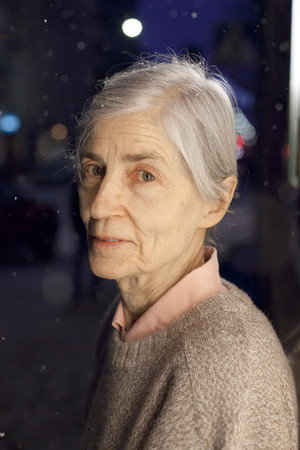
Rose Lowder Movies, TV Shows, and Filmography
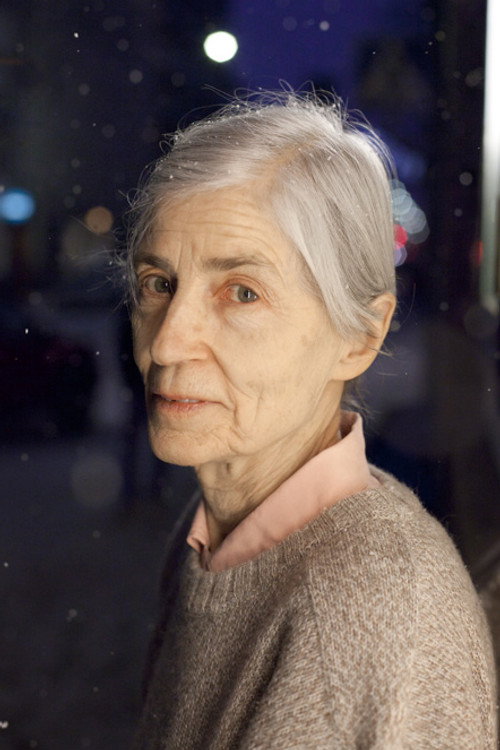
Rose Lowder
Directing
Biography
Rose Lowder (born in 1941 in Miraflores, Lima, Peru) is a French-Peruvian filmmaker. From 1947 to 1958, Lowder studied at the Colegio San Silvestre, Miraflores. She then specialized in painting and sculpture studies in artist’s studios and art schools in Lima, Peru (The Art Center (1951-1957), La Escuela de Bellas Artes (1957-1958) then in London (Regent Street Polytechnic, 1960-1962), Chelsea School of Art (1962-1964). While in London, she pursued artistic practice while working as an editor in the film industry (1964-1972). After 1977, Lowder worked on the visual aspect of the cinematographic process and had Jean Rouch, as well as his department from the Université Paris X, and presented a part of her research for a PhD entitled ‘Le film expérimental en tant qu’instrument de recherche visuelle/Experimental film, a tool for visual research’ (1987). In action since 1977, she has been programming rarely shown films as the co-founder of the Archives du film expérimental d’Avignon (AFEA, 1981), aiming to acquire 16mm films and paper documents, as well as publishing several books; Lowder was thus able to make these works more accessible to the public: ‘La part du visuel, films expérimentaux canadiens/ The Visual Aspect, Canadian expérimental films’ (AFEA, 1991), ‘L’Image en mouvement’ (AFEA, 2002), ‘Images/discours’ (AFEA, 2006). From 1996 to 2005, Lowder was an associate professor at the Université de Paris I and taught practice, history, theory and aesthetics. By focusing her research on visual perception in relation to the cinematographic means of expression, Lowder concentrated on the various ways in which one can alter the graphic and photographic visual features of the images as it metamorphoses in time. As a result of this work, she was able to compose the image in the camera by interweaving the frames as the film strip passes the lens several times. This method of working is meticulous and complex because it consists of recording a series of images, frame by frame, in the camera, in order for them to appear simultaneously when projected on the screen.
Filmography Movies
Acting
What Did You Eat Today? Rose Lowder
The latest in an ongoing series of portraits including inventors Maurice Seddon and Hugh de la Cruz. Here, filmmaker Rose Lowder prepares a macrobiotic meal in her tiny flat in Paris in October 2005. As Rose describes what she is cooking and why, we hear about Rose's childhood spent in Peru through to her current life in Avignon and glimpse a singular creator.
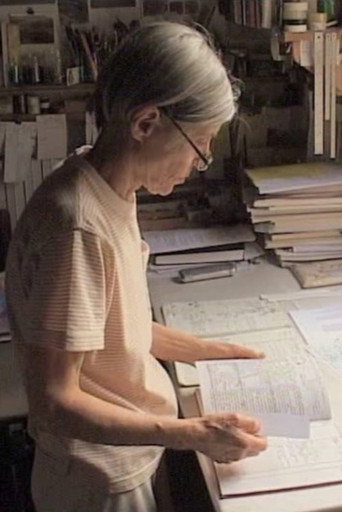
Cinexpérimentaux #5 : Rose Lowder
Rose Lowder is an artisan of cinema. Her 16mm camera takes the place of a loom for the weaving of images. She has consecrated her life to these tapestries, these embroideries whose motifs have for many years come from nature, in a state of incessant becoming. Like her elders, the Impressionist painters, she renders her bouquets stroke by stroke, image by image, color after color, to give life to her pointillist compositions in motion.
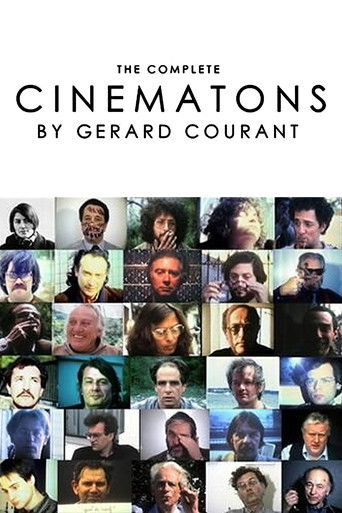
Cinématon
Cinématon is a 156-hour long experimental film by French director Gérard Courant. It was the longest film ever released until 2011. Composed over 36 years from 1978 until 2006, it consists of a series of over 2,821 silent vignettes (cinématons), each 3 minutes and 25 seconds long, of various celebrities, artists, journalists and friends of the director, each doing whatever they want for the allotted time. Subjects of the film include directors Barbet Schroeder, Nagisa Oshima, Volker Schlöndorff, Ken Loach, Benjamin Cuq, Youssef Chahine, Wim Wenders, Joseph Losey, Jean-Luc Godard, Samuel Fuller and Terry Gilliam, chess grandmaster Joël Lautier, and actors Roberto Benigni, Stéphane Audran, Julie Delpy and Lesley Chatterley. Gilliam is featured eating a 100-franc note, while Fuller smokes a cigar. Courant's favourite subject was a 7-month-old baby. The film was screened in its then-entirety in Avignon in November 2009 and was screened in Redondo Beach, CA on April 9, 2010.
Souvenirs/Rouen
Fugitive images of the northwestern city of France.
Printemps à Beijing
"One year before the massacre of Tian An Men [...] a few hundred meters from this immense square, where the tanks were going to crush the resistance, under the debonair gaze of Mao [...] I was loaned a tiny, autofocus camera, allowing me to shoot without framing, the lens wedged on my right hip. Everything is captured in clusters of images, edited directly into the camera. The diary of a stroller who travels through Beijing on foot and by bicycle - a cyclist among the cyclists who circulate in slow and tight flows." - Sudre
Fugues d'été : La Fage
The bamboo grove of the Andes. Are we in the East? A market. Hanging clothes, spots of colors. The farm of La Fage.
Cinématon I
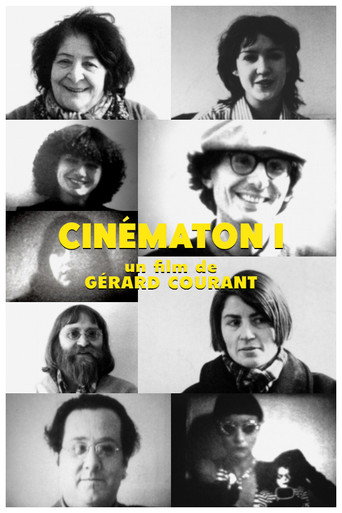
Reel 1 of Gérard Courant's on-going Cinematon series.
Cinématon n°6 : Rose Lowder
Portrait of French-Peruvian filmmaker Rose Lowder shot in Paris (France) on February 17, 1978 at 11:45 AM.
Production
Retour d'un repère composé
In Retour d'un repère composé the same material is presented successively in three different versions : the first third is a straight single print which corresponds exactly to Retour d'un repère. The second third is a combined picture printed twice onto the same film strip (the second printing being in another tone and shifted back one frame) and the third section is a combined image printed in a similar way thrice. The length of Retour d'un repère composé is necessary : in the process of viewing the film the work gathers momentum thus giving access to a more intricate visual experience. "Composed recurrence" is a rough translation of Retour d'un repère composé as one loses the "point of reference" aspect concerning "repère".
La Source De La Loire
The film starts in the Department of Ardèche with the Mont Gerbier de Jonc (1551 m) from where emerges the "true" source, the official, most distant one from the mouth of the Loire (1012 km), the longest wild river in France. The work looks closely time-wise on the first kilometers of the river's water flow. The scene's sound meets up with us at the end.
The Sunflowers
The film presents a field of sunflowers. The focus is adjusted frame by frame in succession according to a series of patterns on particular plants situated in different parts of the field. The diverse configurations placed on separate frames of the film strip appear, when projected successively, simultaneously on the screen. Thus, filmed one after another at different focal lengths, the sunflowers combine during projection to form one spatiotemporal image. LES TOURNESOLS COLORES is a capricious version of the film. - Film Makers' Coop
Impromptu
The title of “Impromptu” reflects both its creating process and the trait of life taking an unexpected course. This film intertwines time and space by being filmed frame on frame, in surprising locations, during a surprising time… but exactly this was the idea of the creator: contingency and visual improvisation. —Kaunas International Film Festival
Bouquets 1-10
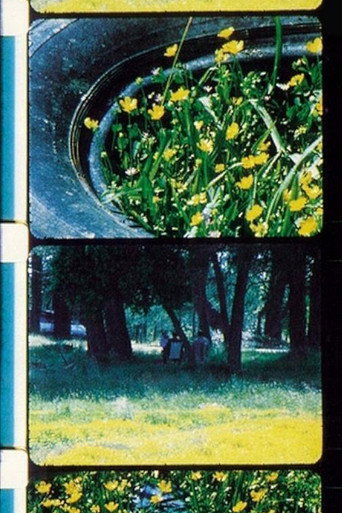
Bouquets 1-10 is Lowder’s first collection in an ongoing series of one minute episodes, each composed of footage shot around a general geographic location that has been alternately woven, frame by frame, into a single film reel and connected through the interstitial still life image of a flower that cues the beginning of each integrated film Bouquet. Each bouquet of flowers is also a bouquet of frames mingling the plants to be found in a given place with the activities that happen to be there at the time. Lowder uses the film strip as a canvas with the freedom to film frames on any part of the strip in any order, running the film through the camera as many times as needed.
Roulement, rouerie, aubage
This reel consists of three short films, two in black and white and one in color, that treat of a water wheel on the Sorgue. The essence of the work rests on a series of cross-references that are set up between the operational mechanisms of the filmed object and the recorded characteristics foregrounded by the choice of film stocks and filming circumstances. The title reflects the process involved. Roulement = rotation, rouerie = wiliness, aubage = paddle wheel unit. - Film Makers' Coop
Quiproquo
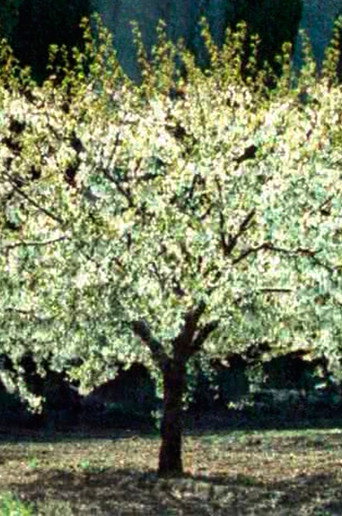
Quiproquo is a dialogue on the balance to be found between nature and social-industrial technology. As the film refers to the economy of the means involved in relation to what is expressed, it is both a reflection on the potentialities of the medium and an enquiry concerning the implications of the reality portrayed. It is a question of limits and possibilities, the beauty and tragedy of the world, with a critique of contemporary society’s dominant choices constantly in the background. Filmed in Berre l’Etang, Bouches du Rhône, in the villages of Orgon, Bouches du Rhône and La Coucourde, Drôme, on the roads to Beaumont-du-Ventoux and Carpentras, Vaucluse, and Tarascon, Bouches du Rhône.—Canyon Cinema
Retour d'un repère
The procedure of separating and extracting certain aspects of a scene by adjusting the focus of a series of frames in succession according to various organizational patterns is developed in Retour d'un repère. While the filmic operations are structured in relation to a limited space (a branch over a 19c duck pond), the filmic process rests on a visual transformation of a pantoun, a verse form borrowed from literary rhetorics, which characteristically transforms itself gradually and continuously in a precise manner. - Lightcone
Côté jardin
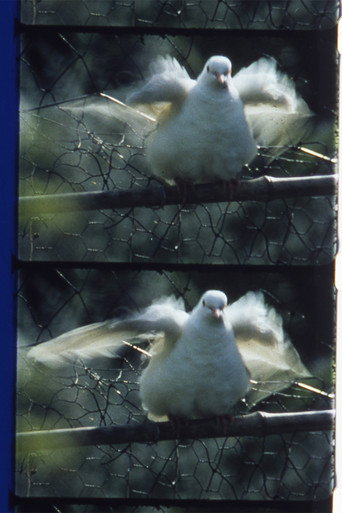
A quick view of three remarkable organic gardens: Le Tomple, Le jardin du Mas d’Abri in the department of Gard and Le jardin des Sambucs in the department of Hérault. The film goes over their general layout along pathways amongst the vegetation, ponds and people or animals that happen to be there at the time.
Gallery