Nancy Holt Movies, TV Shows, and Filmography
Nancy Holt
Directing
Biography
No biography available.
Filmography Movies
Acting
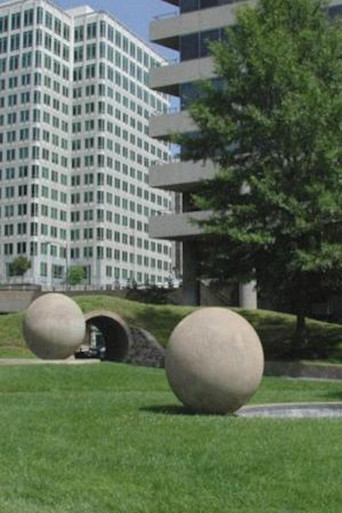
Art in the Public Eye: The Making of Dark Star Park
This piece documents the process behind the creation of Holt's major public art installation, Dark Star Park, in Arlington, Virginia. The park, which features giant concrete spheres and pipes, allows the visitor to reconsider the experience of space, earth and sky within an urban context. It also serves as a kind of contemporary Stonehenge: once a year, on August 1 at 9:30 am, the shadows of the objects exactly align with outlines on the ground. Interviews with the artist, the architects, engineers, contractors, and the public, among others, reveal Dark Star Park as both a public sculpture and a functioning park that reclaims a blighted urban environment.
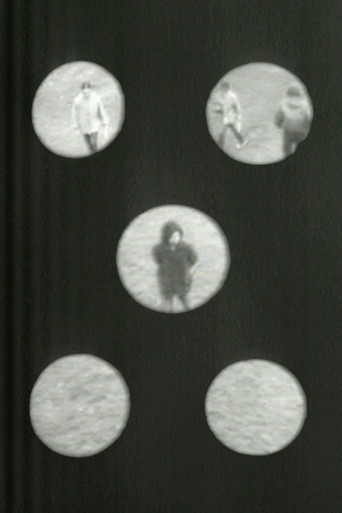
Going Around in Circles
Going Around in Circles is an early video experiment in which Holt explores perception and point of view. A board in which five circular holes have been cut has been placed in front of the camera. Through the holes, which are covered and uncovered, five subjects are seen moving between five points, turning in circles, and following instructions. The artist and her subjects are heard discussing their experience of the performance, how it is perceived on the ground and through the playback monitor, and the different scales and viewpoints created.
Boomerang
Originally broadcast on public television in Amarillo, TX, Richard Serra’s BOOMERANG features Nancy Holt framed in a medium shot with a pair of headphones on her ears. We observe her as she speaks and then hears her words relayed back to her through a delayed transmission. Remarkably eloquent for one caught in such a feedback loop, Holt provides a monologue on experiencing time, thought, and oneself through technology. She remarks, “I have a double take on myself. I am once removed from myself … we are hearing and seeing a world of double reflections and double refractions.”
Regrouping
In this experimental film, Borden explores the dynamics among the members of a woman’s group. As she interviews people who know them, such as Joan Jonas, the group shoots ‘artistic’ scenes of themselves – but Borden feels they aren’t fully grappling with issues of sexuality and politics. Are they a serious group – or just friends? After showing an early edit of the film to the group, its members, upset, close ranks. Undeterred, Borden incorporates the group’s arguments into another edit, filming larger groups commenting both on the original one and on consciousness-raising groups in general. Uncredited voices include those of Barbara Kruger and Kathryn Bigelow.
Mono Lake
Mono Lake is a document of a unique natural environment, a "home movie" of the artists' 1968 road trip, and an intimate view of three seminal figures in the earth art movement as they interact with the Western landscapes that are so central to their work.
Match-Match Their Courage
Artists Nancy Holt and Charlemagne Palestine attempt to have a conversation with one another while their voices are distorted.
Production
Up and Under
Up and Under is an impressive piece of land art designed by American artist Nancy Holt. Up and Under was completed in 1998. The tunnels included in Up and Under are aligned with the main compass directions, and the pools of water are called “the eyes of the earth” according to a custom of the Seneca Indians.
Swamp
The action of the film is direct: Holt walks through the tall grasses of a swamp while filming with her Bolex camera, guided only by what she can see through the camera lens and by Smithson's verbal instructions. The viewer experiences the walk from Holt's point of view, seeing through her camera lens and hearing Smithson's spoken directions. Vision is obstructed and perception distorted as they stumble through the swamp grasses.
Road to Nowhere
Florida Keys, FL, 1971.
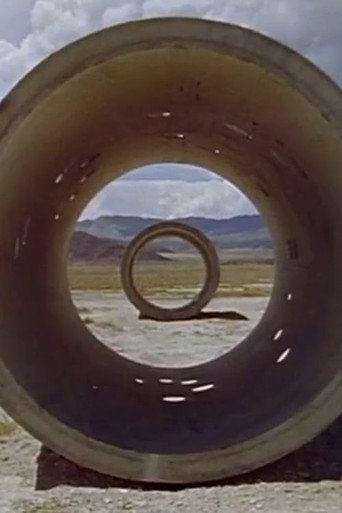
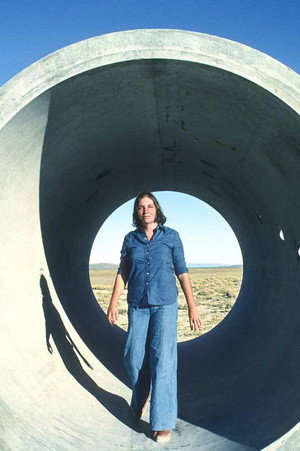
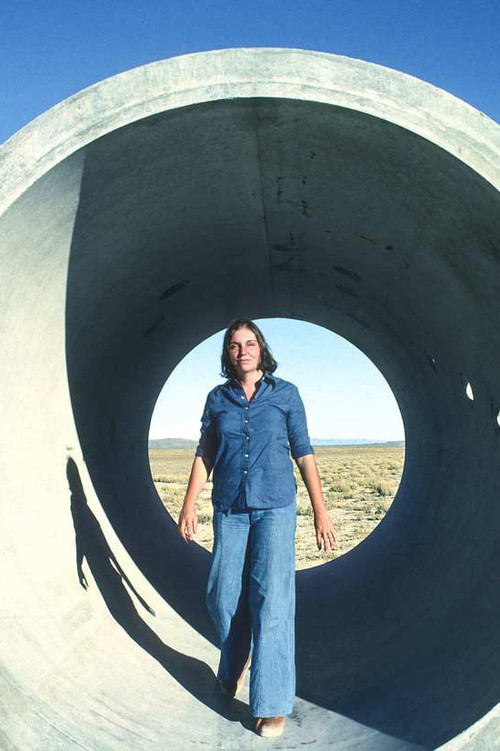
Sun Tunnels
Sun Tunnels documents the making of Holt's major site-specific sculptural work. Completed in 1976, the sculpture features a configuration of four concrete "tunnels" 8 feet long and 9 feet in diameter.
Art in the Public Eye: The Making of Dark Star Park
This piece documents the process behind the creation of Holt's major public art installation, Dark Star Park, in Arlington, Virginia. The park, which features giant concrete spheres and pipes, allows the visitor to reconsider the experience of space, earth and sky within an urban context. It also serves as a kind of contemporary Stonehenge: once a year, on August 1 at 9:30 am, the shadows of the objects exactly align with outlines on the ground. Interviews with the artist, the architects, engineers, contractors, and the public, among others, reveal Dark Star Park as both a public sculpture and a functioning park that reclaims a blighted urban environment.
Going Around in Circles
Going Around in Circles is an early video experiment in which Holt explores perception and point of view. A board in which five circular holes have been cut has been placed in front of the camera. Through the holes, which are covered and uncovered, five subjects are seen moving between five points, turning in circles, and following instructions. The artist and her subjects are heard discussing their experience of the performance, how it is perceived on the ground and through the playback monitor, and the different scales and viewpoints created.
East Coast, West Coast
East Coast, West Coast, Holt and Smithson's first collaborative experiment with video, takes the form of a humorous bi-coastal art dialogue. Joined by their friends Joan Jonas and Peter Campus, Holt and Smithson improvise a conversation based on opposing - and stereotypical - positions of East Coast and West Coast art of the late 1960s. Holt assumes the role of an intellectual conceptual artist from New York, while Smithson plays the laid back Californian driven by feelings and instinct. Their deadpan exchange ironically lays bare the limitations and contradictions of both sides in the debate.
Mono Lake
Mono Lake is a document of a unique natural environment, a "home movie" of the artists' 1968 road trip, and an intimate view of three seminal figures in the earth art movement as they interact with the Western landscapes that are so central to their work.
Underscan
In Underscan, time and the visual image are compressed. A series of photographs of my Aunt Ethel's home in New Bedford, MA had been videotaped, and re-videotaped while being underscanned. (The underscanning device is a structural framework particular only to video; it compresses the picture so that the edges can be seen precisely; it does away with the variation that occurs between monitors in the amount of the image which is visible.) Because of this underscanning process, each static photo image, as it appears, changes from regular to elongated to compressed or vice versa. Excerpts from letters from my aunt spanning 10 years are condensed into 8 minutes of my voice-over audio. Certain yearly occurrences repeat in an auditory rhythm, coinciding with the cycle of yearly changes.
Pine Barrens
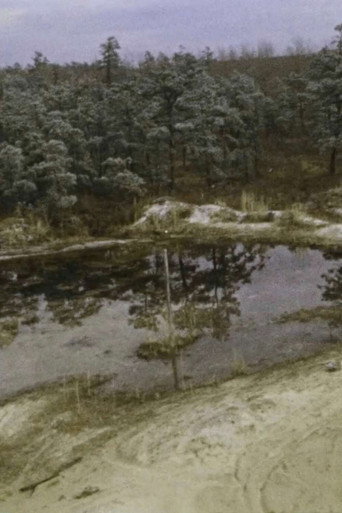
Pine Barrens is concerned with evoking through film a barren wilderness in south-central New Jersey. The camera is always in motion — tracking, pivoting, and walking through the landscape. Though they are never seen in the film, the voices of the local people, the 'Pineys,' are heard relating their feelings about the land, their attitudes about city life, their myths of the area, etc. their voices and the music of 'Bill Patton's Pine Barrens Trio' add a psychological dimension to the landscape.
Gallery