Moniek Kramer Movies, TV Shows, and Filmography

Moniek Kramer
Writing
Biography
No biography available.
Filmography Movies
Acting
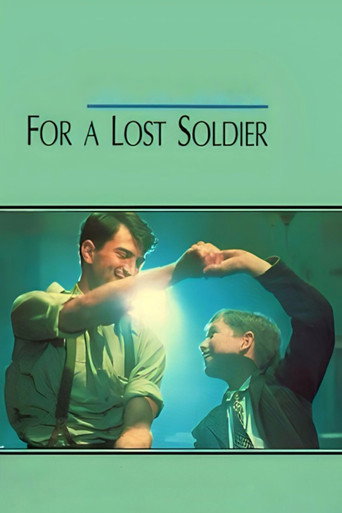
For a Lost Soldier
In the occupied Netherlands near the end of WWII, a young teenager, Jeroen Boman (Maarten Smit) is sent to the Dutch countryside to avoid the war in Amsterdam. While living with his adopted family, Jeroen meets and becomes friends with a Canadian soldier named Walt Cook, who is stationed at the same town he is staying at. Joroen and Walt spend a lot of time playing around and eventually a romantic relationship develops between them. The boy’s sexual curiosity leads him to have a sexual experience with Walt, an encounter that is shown with some vague detail but without actually showing any nudity, even though sexual intimacy between the two of them is implied. Overall, the movie handles this difficult subject with an elegant style and feeling, without having the adult-child relationship overwhelm the viewer and thus allowing the movie to be seen as just a wartime relationship between two people that marks an important time in a young boy’s life.
Time
The point of departure for this film is the 1981 composition De Tijd by Dutch composer Louis Andriessen. Van der Keuken leaves the music undisturbed as an autonomous soundtrack and has the images engage in a sort of battle with it. These images are associations, fragments of events, scenes and situations. The film is preceded by a text by Bert Schierbeek.
After the Tone
How do you deal with the fact that someone close to heart has suddenly disappeared without a trace? Can you go on living whilst waiting for his return?

The Silent Pacific
Unrelenting pessimism dominates this slow-paced, dark film, the debut feature from director Digna Sinke dedicated to an archetypal born loser named Marian (Josee Ruiter). Marian is a journalist who has been working in Latin America and who arrives home just after her father dies to find out that the man she had married for purely political reasons might be deported because the authorities found out he was not living with her. Meanwhile, Marian is upset that her mother and sister are keeping her mentally handicapped brother in an institution, and she goes there to get him released into her custody -- a mistake it turns out. He is actually worse off with her, and vice-versa. On top of everything, Marian cannot break away from the depression she feels over a tragic incident that happened while she was in Latin America -- and anything she does is colored by that moment from the past. These burdens become almost too much to bear, both for Marian and the viewers.
Toy
An short anti-cruise missile film created in collaboration with a group of filmmakers.
Gekkenbriefje
Gekkenbriefje (Alternatively: Crazy Going) is a 1981 Dutch film directed by Olga Madsen. It is based upon the book "Zorg dat je een gekkenbriefje krijgt" by Ger Verrips. It was the first movie that Olga Madsen directed. The film is about a Dutch soldier who does not agree with the Dutch politics surrounding the Indonesian War of Independence.
Production

Accused
An assistant prosecutor zealously pursues a conviction in the case of a pediatric nurse accused of murdering her patients, but doubt arises when her evidence shows that the infants may have died of natural causes.
Making Waves
Making Waves is the story of Cella (Jacqueline Blom) and her 71-year-old mother Johanna (Kitty Courbois). Life smiles upon Cella. Happily divorced, having two children and a successful job as a presenter at a local station, for which she interviews people every morning who take the ferry across the IJ river. In her enthusiasm, Cella resembles her mother, once a celebrated violinist, but the similarity also causes friction between the two women. Just when Cella meets a new love, her father's sudden death puts her life on a different track. Johanna increasingly muddles past and present and brings back fragments of memories that point to a painful secret she carries on her back. Cella tries to dig up the truth.

Madame Jeanette
When her husband Ted is put in jail Bibi suddenly needs to provide for herself and decides to contact fortune teller Madame Jeanette.

Gallery