Acting
No biography available.
Mid-19th-century, Baltic Sea port city of Lubeck, Germany. Follows the fourth generation of the Buddenbrook mercantile family as Tony and Thomas reach the age of marriage. Fatefully impeded every step of the way, the Buddenbrooks struggle as economic hardship and personal defeats weigh down family relations.
Bella Figura is a play where the stage direction "flottement" (a suspension, indeterminacy, or oscillation) occurs frequently, indicating a moment of silence when the characters and audience are left in ambiguous tension. The playwright Yasmina Reza wrote Bella Figura specifically for the Schaubühne director Thomas Ostermeier, and I imagine that she included these floating silences with him in mind.
A family spends three summer days in a beautiful lake mansion close to Berlin. Together with her new lover, Irene visits her brother Alex, who still inhabits the house with Irene's writer son Konstantin. Konstantin's girl-friend pops in, too, and all of them drift away from each other more and more.
Gerrit Frings is facing ruin at the age of 34. After the end of his company and the suicide of his partner Markus, he is also sued by his widow Sandra. Allegedly, Gerrit owes Markus a lot of money. In reality, however, it was the other way around and his self-denial of his own situation was ultimately the reason for Markus' suicide. Gerrit's wife Claudia supports him in this difficult situation. But Gerrit falls in love with Sandra, of all people.
Teenage siblings Hannah and Timotheus grow up in a strict evangelical family and lead seemingly fulfilling lives in their free church community. When Hannah falls in love with their new neighbour, Max, and Timotheus discovers he is attracted to men, their feelings collide with their family's values.
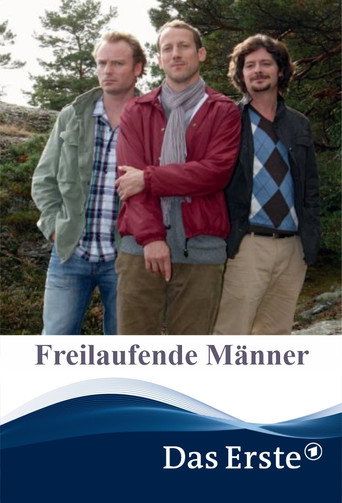
Some call it a men's holiday, the other flee from themselves: Thomas, Jens and Malte have rented a holiday home on a secluded Swedish lake - the complete contrast to life at home. They are only partially satisfied with that for different reasons. One is around 40, the first interim balance revealed weak points. But even in the Swedish forest, where there are at least one moose in addition to the free-running men, the guys catch up on the reality quickly. Because the wasteland is not as gullible as hoped ...
A story set in a small village in Sudetenland between 1937 and 1945. "Habermann" is based on true events.
Julian is a psychiatric patient and wants to walk from Berlin to southern Germany. He believes that through the power of walking he can heal his friend's father, who has died of a heart condition. First, he runs into Ju, a young doctor, who he soon meets again by chance. She feels unhappy, searches for her heart and spontaneously joins the likeable dreamer on his way to Tuttlingen, where the sick man lives. In a tourist resort, they are joined by a frustrated wife and mother.
Once upon a time there was a girl called Helene. And because her father was king and her mother queen, she had to be a princess.
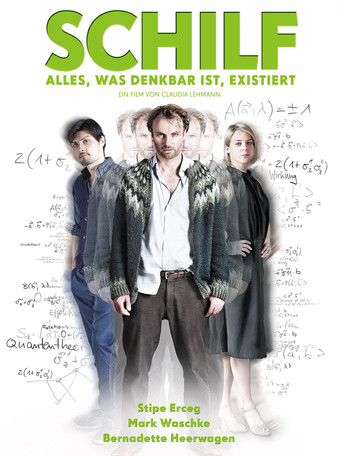
Sebastian (Mark Waschke) is a physics professor at the University of Jena and dealing for years with parallel universes. Meticulously, he tries to prove its existence scientifically. His college friend Oskar (Stipe Erceg), professor of theoretical physics at CERN in Geneva, smiles at Sebastian's firm belief in parallel universes and the many-worlds theory. In order to devote himself to the evidence in peace, Sebastian brings his son Nick to a summer camp, while his wife Maike (Bernadette Heerwagen) is on vacation in the mountains. At a rest stop Nick disappears out of the car and so for Sebastian a nightmare begins. Increasingly he is loosing more and more control. What really happened? It is fatal to his own theory? And who is this mysterious Schilf, which occurs abruptly in Sebastian's life?