Directing
No biography available.
Segalove re-enacts the trials and travails of her desperate, hormonal, pubescent years with actors dancing their way through what looks like a techni-color version of the Cleaver’s backyard. She plays herself, getting questionable advice from girlfriends, begging her mother for a bra and falling in love for the first time, with Moondoggie in Gidget Goes Hawaiian.
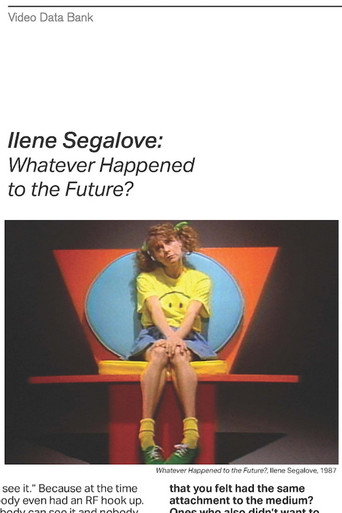
In a series of wistful vignettes, Segalove looks at how her childhood vision of the future holds up (or doesn't) in adulthood. Commissioned by the Los Angeles County Museum of Art.
Addressing the camera, Segalove confesses to plagarizing her 5th grade report, The Story of Coal.
Segalove takes her mother as subject in these short pieces, recording her stories, her advice, and her daily routine. What results is a portrait of a contemporary mother-daughter relationship, touchingly devoid of drama and full of whimsical humor. For example, in one piece, Ilene’s mother laments over a pair of shoes her daughter has chosen to hang on the wall instead of wearing, saying, ”With you, everything is art”.
In 2012, Ilene Segalove talks to herself from 1972.
The end of the world does not have to be all doom and gloom. Hildegarde Duane finds the humorous side of a nuclear meltdown in this video where two people embrace in the knowledge of certain death. What better way to spend the final minute before the apocalypse? (LUX)
The Riot Tapes (1984) offers a sharp and ironic take on Segalove’s college years during the Vietnam War protests. Using the aesthetics of 1980s television, Segalove reenacts the clichés of 1960s campus life—sex, drugs, politics, and love—with satirical humor. Employing reenactments and archival footage to recount the artist’s political involvement in college, her boyfriend’s becoming-anorexic while dieting to evade the draft, and her discovery that art could offer her a space for political commentary, the work not only critiques the sentimentalization of ’60s activism but also interrogates how the Reagan era reshaped public memory, turning a deeply personal lens onto the political and cultural fissures of both decades. - Amant