Guy Sherwin Movies, TV Shows, and Filmography
Guy Sherwin
Directing
Biography
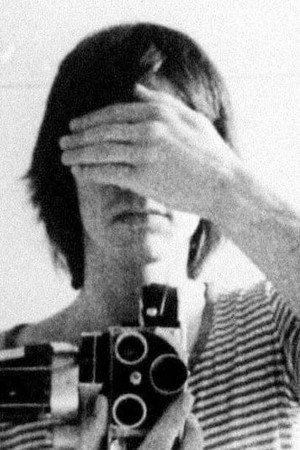
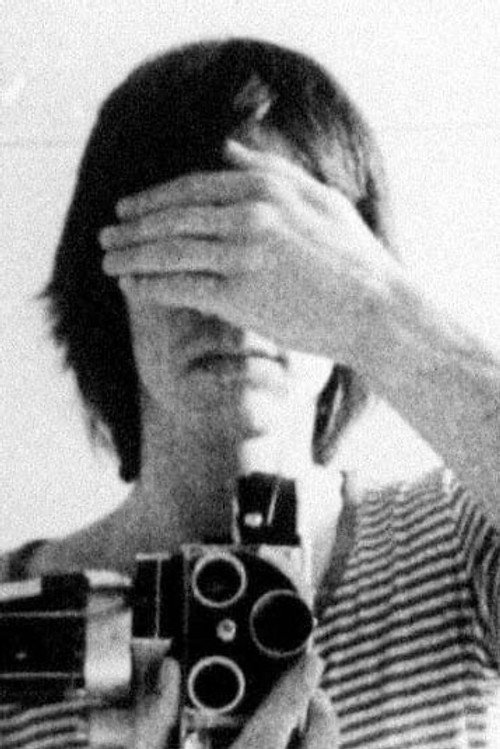
Born in 1948, Guy Sherwin studied painting at Chelsea School of Art in London. Inspired by films and expanded cinema from the London Filmmakers’ Co-op, he began making films and acquired laboratory skills while working there during the 1970s. His 16mm films are often highly concentrated in their form, but very diverse in terms of their imagery and approach. The Short Film Series (1975-ongoing) and live performance pieces such as Man with Mirror (1976-ongoing) involve human, animal and natural phenomena transcribed as filmic subjects, while his optical sound films and performances explore a wide variety of abstract audiovisual ideas.
Filmography Movies
Acting
New Shores
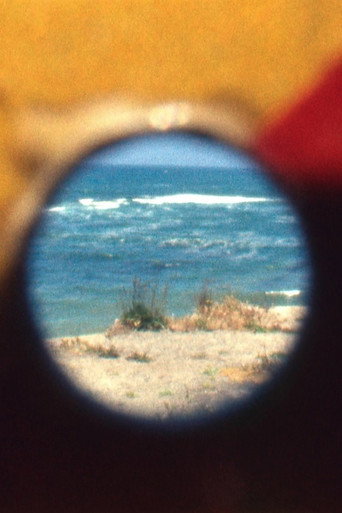
NEW SHORES is a sister film to IN THE STONE HOUSE in many ways. Like the latter film, it consists of earlier footage edited in recent years. It could be seen as a sequel to IN THE STONE HOUSE especially since it begins with a cross-country journey to the West Coast, where I settled, and concludes with a visit, in 1987, to the “stone house” in rural New Jersey. Even though there is some sort of time line that can be imagined, the film stands on its own. It is simply a series of episodes that touch upon facets of living in a new area with new weather, new people, new identities and stubborn old fears. The Bolex camera goes to work across landscapes and living areas, workplaces and gatherings. A dance of images: can beauty partner with dread and death? It’s a film of the coexistences that percolate beneath the surface of ordinary events. A film of useless hopes and baseless fears.
Paper Landscape
An expanded film performance by Guy Sherwin using a transparent screen and white paint
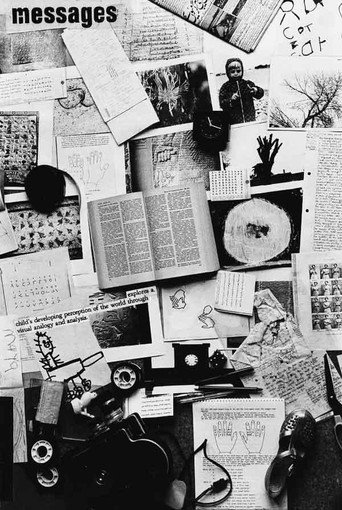
Messages
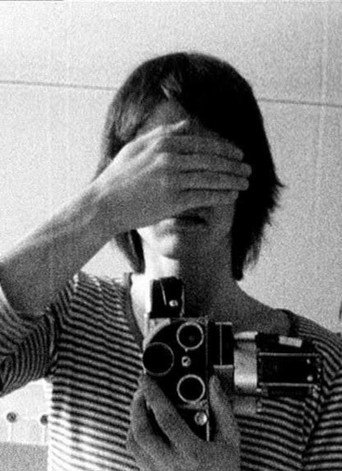
"Made during my daughter’s early childhood. It’s not about her, but it’s a response to her questions about the world that implicitly challenge things we take for granted – the visual appearance of the world, ambiguities in language, the ways we communicate." – Guy Sherwin
Production
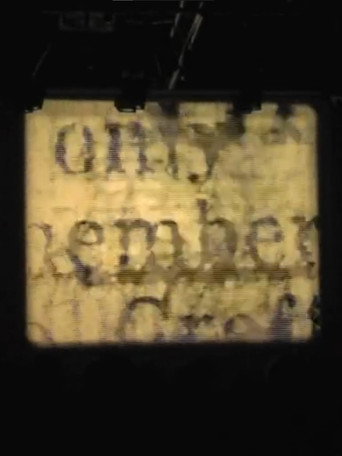
Newsprint #2
A performance for two projectionists using two 16mm projectors with freeze-frame. This performance version further animates the newspaper text by using intermittent projection, pausing and re-starting the film on its way through the projector. The pauses allow us to read chance fragments of the newspaper. In performing the work two identical prints are shown superimposed with a slight difference in image size, which varies throughout the performance. The projectionists attempt to bring the two films into synchronisation with each other by alternately freezing and running the films. During these brief periods of synchronisation something unexpected happens as a result of the slight misregistration of the two identical images and of their accompanying sounds.
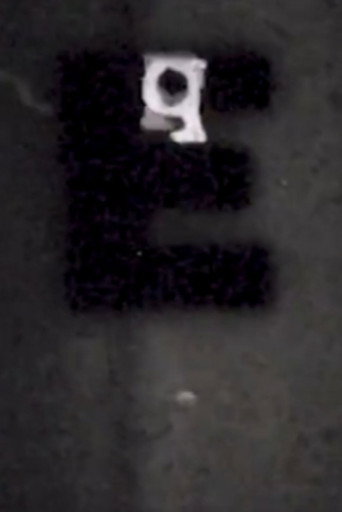
Vowels & Consonants
A film collaboration using six projectors that evolved from Lynn Loo's film o and Guy Sherwin's printer installation bdpq. The images were produced by printing letterforms directly onto raw 16mm film, and their shapes make sounds as they pass through the projectors' optical sound heads. These optical sounds may at times resemble the uttered sound of the letterforms. The work is sometimes performed as a live interaction with musicians.
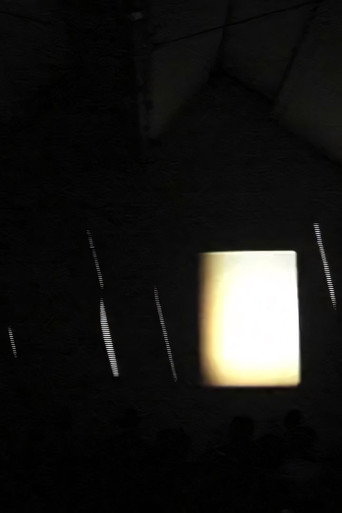
Sound Cuts
“Black film stock is repeatedly cut and rejoined. The cuts are made with the angled blade of a splicer normally used for joining sound film. At each cut we see an angled flash of light followed by a thud of sound. The film combines rhythmic intervals from one cut per second to twenty-four cuts per second, spread across 6 projectors”.
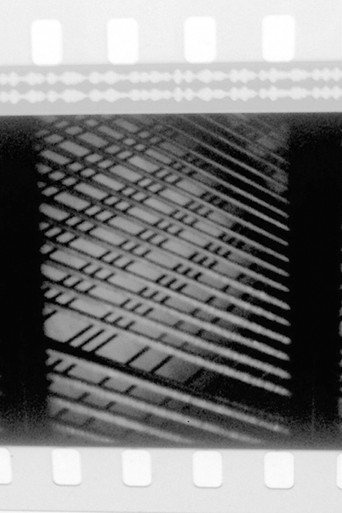
Notes
Made using a super 8 sound camera. The microphone is attached to a stick protruding from the camera, and kept just out of sight. This image-and-sound-gathering device is used to 'play' the open strings of a piano.
Cycles #3
This is a live projection event for two 16mm projectors and two loudspeakers. The material in Cycles (1972/77) is recycled for two screens and two soundtracks, with one screen set inside another, giving rise to a surprising induced colours and rhythmic patterns.
Mobius Loops
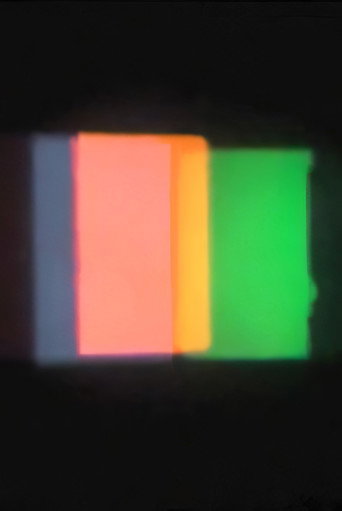
A performance work for multiple projectors in which the starting point is my sound & image experiments of the 70s. The film and sound material was prepared in one simple action by bleaching away the side of a length of black leader, leaving a clear strip running along its length. The film has two sets of perforations and is twisted into a loop, known as a Mobius Loop. On projection, the strip of projected light switches from side to side, followed by a change in tone of the sprocket holes. Three 16mm projectors lie on their sides, and the loops are projected onto the screen as stacked blocks of light, gradually coloured by gels. The performance also makes use of the sound tone controls of the three projectors. First performed at Star & Shadow Cinema, Newcastle 2007 with sound mix by Lynn Loo. G.S.
Man with Mirror
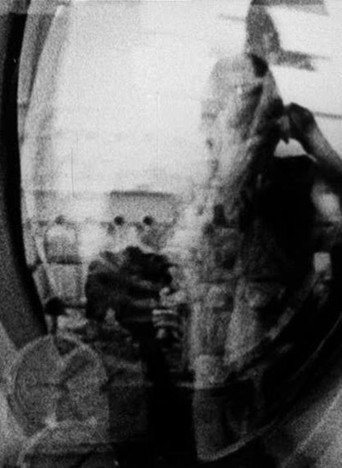
The filmmaker's live interaction with his on-screen image which is projected onto a hand-held mirrored screen.The screen is white one side and mirrored the other, and is used by the performer to either 'catch' the projected image, or reflect it around the cinema space. The image on Film is of the same activity happening in a sunlit landscape. Visual echoes are set up between the live event and the recorded one.
Mile End Purgatorio
Mile End Purgatorio is Guy Sherwin and Martin Doyle’s one minute hymn to the London road via its shop signs. A heady rapid-fire brew of Dante, Shakespeare, the Bible and William Blake, its visual text is storefront correlated, its theme the crisis on the journey, its rhythms all of daily life, and celebratory in its observations of the seemingly known.
At the Academy
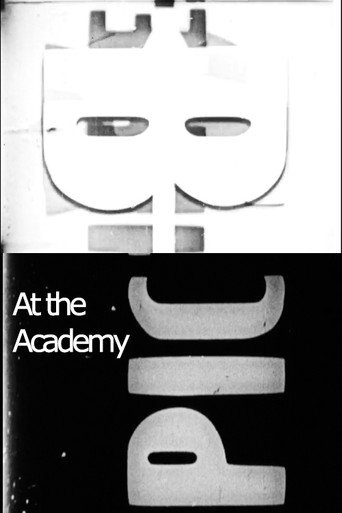
A found-footage film made entirely from Academy leader, which is normally used to cue the start of films. The film was hand-printed on a home-made contact printer. It was rolled back and re-printed several times over, to create a complex layering of both image and sound.
Short Film Series
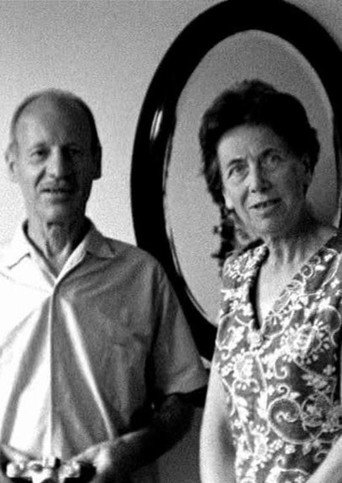
Guy Sherwin's SHORT FILM SERIES was made between 1976 and 2014. Eventually he issued 34 films. Some are single studies of light, focused on the reflections in an eye shot in close-up. Others are domestic, as in the PORTRAIT WITH PARENTS or BREATHING .... Many deal with two rates of time measurement, as in CLOCK AND CANDLE, or construct visual paradoxes, as in the shuddering stasis of METRONOME - an illusion caused by the clash between the spring-wound mechanisms of the Bolex camera and of the metronome itself. In BARN DOOR the semi-strobe effect of light pulsations flattens the distant landscape. ... Interestingly, Sherwin has recently returned to the series after almost twenty years, with studies of animals and insects which in part recall the fascination with the 'invisible' side of nature felt by the surrealists, and seen in the scientific writing of Roger Caillois and the films of Jean Painleve during the 1930s.
Gallery