Acting
No biography available.
"Tomorrow, I won't be alive anymore," Francesco tersely tells his family, gathered for dinner. He has decided to commit suicide because he can't bear living without his wife, who died three months earlier, and can't imagine the idea of getting used to the pain. After the initial shock, his parents and his sisters try to make him change his mind.
"Documents of the staging" of the play The seagull at the Orologio Theatre in Rome.
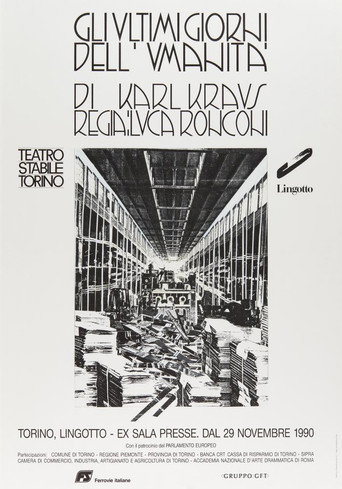
The last days of humanity by Karl Kraus, a mammoth drama - almost 800 pages in the Adelphi edition - staged by Luca Ronconi in the Lingotto in Turin, broadcast by Rai
Elisa is only forty when an incurable disease takes her from her husband and their daughter. Before her heart stops, Elisa finds a way to stay close to her: a gift for every birthday up to her adult age, 18 gifts to try to accompany her child's growth year after year.
Three sisters. Laura, the eldest; Lucia, the middle one; Costanza, the younger. Costanza is wheelchair bound because of an accident caused by Laura. Costanza and Lucia are not aware of Laura's responsibility, but a strange being is: Carlo, who starts blackmailing Laura.
Naples, 1942. To feed her family and respond to her husband Gennaro's inertia, Amalia is forced to enter the black market. To save his wife from prison, the man fakes his own death.
The play wants to explore afterlife, death re-emerging into life even just for an hour in a whirlwind of powerful emotions ranging from disbelief to joy and anger, until total despair and the last goodbye.
Three murderers. A journalist, a postal employee, a rich young lady. They're dead, but they prefer to call themselves "absent". One forgets they're still in a hotel. It's the nightmare of an infernal room that will imprison their existence forever, with their sins, desires and all they know about themselves.