Ericka Beckman Movies, TV Shows, and Filmography

Ericka Beckman
Directing
Biography
No biography available.
Filmography Movies
Acting
The Super-8 Show: Beyond Home Movies
A short survey of the small-gauge narrative film, beginning with the Kuchars' Sylvia's Promise (1962). Primarily focused on East Coast artists, the work of Eric Mitchell, Manuel DeLanda and Ericka Beckman is highlighted.
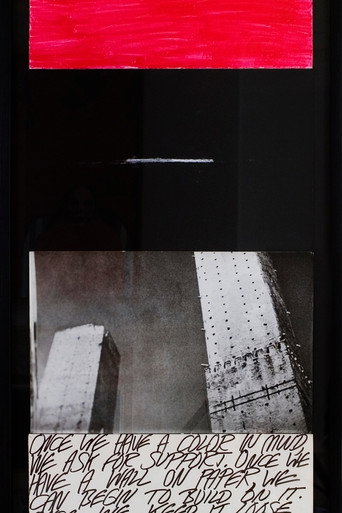
The Red Tapes
A three-part video epic in which avant-garde artist Vito Acconci explores the relationship between the self and national mythology. Through multiple vignettes, Acconci brings together a collage of music, photographs, diorama, experimental theater and his own profile, to tell a semi-autobiographical narrative that, in turn, becomes a critique of the alienated quality of American mythology.
Production

Reach Capacity
Almost forty years after its first appearance in You The Better, the house returns as a character in Beckman’s new work Reach Capacity, now symbolising real estate. The economic and political elements and the structure of the film are closely associated with the most famous of all board games dealing with real estate, Monopoly. Its origins go back to the early 1900s, when Elizabeth Magie created a first version of what she called The Landlord’s Game. Magie’s game had two sets of rules, a Prosperity set and a Monopolist set (only the latter was kept by Parker Brothers when they further developed the game without her). Magie’s aim was to illustrate how society as a whole thrives when monopolies are banished and income is distributed equally. Beckman takes over Magie’s dual game structure by having her screen flip over when a monopoly is reached.
Reach Capacity
Almost forty years after its first appearance in You The Better, the house returns as a character in Beckman’s new work Reach Capacity, now symbolising real estate. The economic and political elements and the structure of the film are closely associated with the most famous of all board games dealing with real estate, Monopoly. Its origins go back to the early 1900s, when Elizabeth Magie created a first version of what she called The Landlord’s Game. Magie’s game had two sets of rules, a Prosperity set and a Monopolist set (only the latter was kept by Parker Brothers when they further developed the game without her). Magie’s aim was to illustrate how society as a whole thrives when monopolies are banished and income is distributed equally. Beckman takes over Magie’s dual game structure by having her screen flip over when a monopoly is reached.
Reach Capacity
Almost forty years after its first appearance in You The Better, the house returns as a character in Beckman’s new work Reach Capacity, now symbolising real estate. The economic and political elements and the structure of the film are closely associated with the most famous of all board games dealing with real estate, Monopoly. Its origins go back to the early 1900s, when Elizabeth Magie created a first version of what she called The Landlord’s Game. Magie’s game had two sets of rules, a Prosperity set and a Monopolist set (only the latter was kept by Parker Brothers when they further developed the game without her). Magie’s aim was to illustrate how society as a whole thrives when monopolies are banished and income is distributed equally. Beckman takes over Magie’s dual game structure by having her screen flip over when a monopoly is reached.
Reach Capacity
Almost forty years after its first appearance in You The Better, the house returns as a character in Beckman’s new work Reach Capacity, now symbolising real estate. The economic and political elements and the structure of the film are closely associated with the most famous of all board games dealing with real estate, Monopoly. Its origins go back to the early 1900s, when Elizabeth Magie created a first version of what she called The Landlord’s Game. Magie’s game had two sets of rules, a Prosperity set and a Monopolist set (only the latter was kept by Parker Brothers when they further developed the game without her). Magie’s aim was to illustrate how society as a whole thrives when monopolies are banished and income is distributed equally. Beckman takes over Magie’s dual game structure by having her screen flip over when a monopoly is reached.
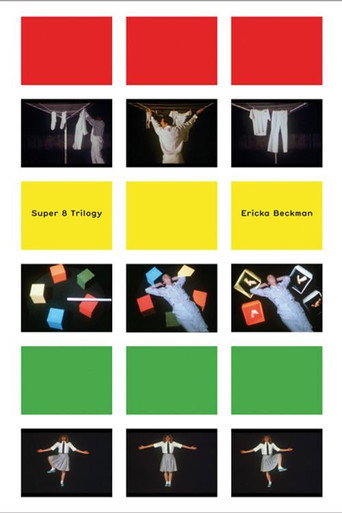
Out of Hand
“OUT OF HAND is a search film, where a small boy returns to a house that is being evacuated, to search for something that he left behind. His method is to follow hidden clues in this house and to respond to the hidden aids in his memory. Back and forth, between inquisition and logic, he constructs a search with two unknowns – ‘What it is’ and ‘Where it is’. Each object he chooses has multiple functions, which extend both into the physical space of his search, and into the imaginary world of his perception and memory.” E.B. 1980
We Imitate; We Break Up
“Mario was a construction; the girl tried to imitate it. But she knew there was more that she could do. Mario limited her. In my imagination I saw a competitive relationship that could only go so far. In making this film I combined the ‘real’ with the ‘constructed’, proving for myself that these two aesthetics could not fuse together; they had to remain apart working in tandem as a relationship, thus their meaning now included competition and cooperation.” E.B.1978
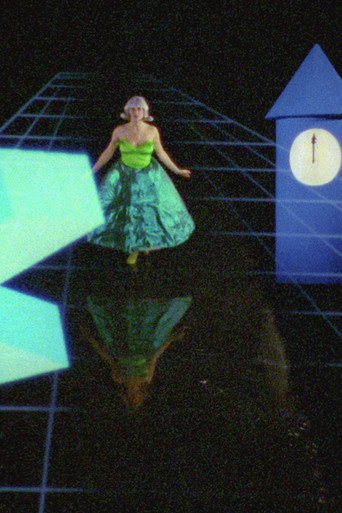
Cinderella
“CINDERELLA is a musical treatment of the fairy tale. I have broken apart the story and set it as a mechanical game with a series of repetitions where CINDERELLA is projected back and forth like a ping-pong ball between the hearth and the castle. She never succeeds in satisfying the requirements of the ‘Cinderella Game’. The film was shot MOS, the dialogue is lip-synched, and along with the out-front score and effects track magnifies the film’s sense of alienation.” — E.B. 1984 - Preserved by the Academy Film Archive in 2017.

Frame Up
Frame UP is an 8-minute dual screen film that utilizes the construction zone of the Walker Art Center’s museum expansion as the platform for a hybrid pinball/croquette game played by two off screen players. The game begins when the crane, spinning at high speed in the center of the site, drops two balls down the chute of an elevator shaft. The construction workers and their materials become the flippers and paddles that careen balls against the obstacles in the construction site as it changes over time
Frame Up
Frame UP is an 8-minute dual screen film that utilizes the construction zone of the Walker Art Center’s museum expansion as the platform for a hybrid pinball/croquette game played by two off screen players. The game begins when the crane, spinning at high speed in the center of the site, drops two balls down the chute of an elevator shaft. The construction workers and their materials become the flippers and paddles that careen balls against the obstacles in the construction site as it changes over time
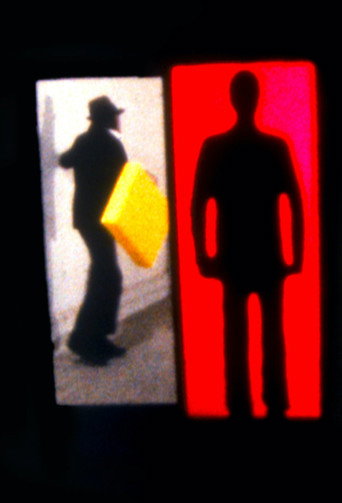
The Broken Rule
“THE BROKEN RULE is my reaction to the American education system, where learning blocks must be acquired by the group before any individual can progress to the next level. My film pictures learning blocks as relay races conducted by male players, where the girls are scores, and the goal is to enter the working world by the end of the game. Mike Kelley, the lead player in my film, makes a ritual out of his mistakes to escape the consequences of his mistakes. In this film, one person’s work is another person’s play, and play creates competition, a component of work.” — E.B. 1979
Gallery