Azucena Losana Movies, TV Shows, and Filmography

Azucena Losana
Directing
Biography
"Born and raised in Mexico City, 1977. I Live and work in Buenos Aires. I attended the Multimedia Arts Degree at the National Arts University in Argentina, the Abigail Child Found Footage workshop and Claudio Caldini's experimental film workshop. My work is related to experimental films, installations and video. I carry out and program the itinerant screening room for films called CINEMA CINICO. I'm also on charge of the mythical laboratory of the film resistance in Latinamerica: Arcoiris Super 8. I am currently working on the enhancement of the film collection of the Mexican Embassy in Argentina. Since 2012 I work with Carolina Andreetti in our project TAPP, a workshop dedicated to the construction of analog projectors with discarded materials or easily accessible for audiovisual ensambles. Received in 2009 the Third Prize of Arts and New Technologies from the Museum of Modern Art in Buenos Aires and Telefonica, in 2015 the exchange scholarship of the University of Sao Paulo / UNA. On 2016 a mention in the National Hall of Arts in Argentina. On 2017 received the Creation Grant from the Nacional Arts Fund in Argentina and the grant for the Art Creators National System Program (SNCA) from the National Fund for Culture and the Arts (FONCA) in Mexico. My films have been screened at the Mar del Plata International Film Festival, BAFICI, (S8) Mostra de Cinema Periferico, La Coruña, España, Kurzfilmtage in Oberhausen Germany, Los Angeles Filmforum's film series Ism, Ism, Ism: Experimental Cinema in Latin America, The Age d'Or Festival in Brussels, VIDEOEX in Zurich, Curta8 in Curitiba Brazil, PAF animation festival in Olomuc, Czech Republic, MEXPARIS MENTAL in France, the International Experimental Film Festival of Moscow MIEFF, the Week of the Experimental Film of La Plata - Argentina, UNCIPAR, among others." -A.L.
Filmography Movies
Acting
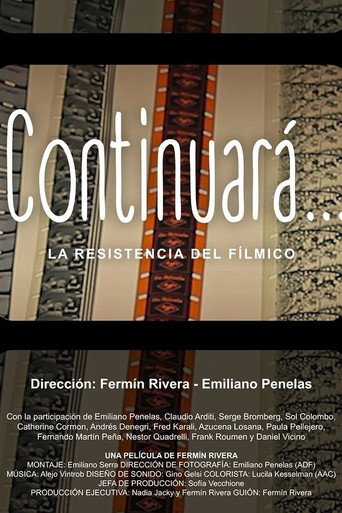
Continuará...
The most transcendent and controversial event since the invention of the seventh art: the disappearance of photographic film. What for many people seems to be simply the result of technological evolution, brings with it paradoxes and contradictions that endanger photographic film heritage and accelerate its deterioration.

Analog Thinking
In a world where technological progress is conceived as an arrow pointing forward, why do some people insist on continuing to work with equipment others refer to as obsolete? Analog Thinking answers that question by documenting the meticulous work of those who choose that path. The screen becomes filled with wonderful objects—optical toys, cameras, projectors, film stock cans, moviolas… And the testimonies from those creators invite us to discover a universe that has a lot to do with both craftsmanship and the collective experience—an instance of thinking with your hands that is only possible with curiosity and patience. And among the words, practices and artifacts, Analog Thinking also saves a place for the images that are born from all of that. And it reminds us that, even in this digital age, they still have a lot to teach us about waiting and making mistakes, surprise and beauty.
Production

Tigre del Carbón
An imaginary place on the map of affections, where hawthorn, orange and plum trees coexist. An island and a valley which climbs stairs of all ages.

Condicionadas
Short film by Azucena Losana.

NN
"Fragments of a few orphan films abandoned in a lab." (the8fest)

La cuarta plantación
During the enhancement of the audiovisual heritage of the Embassy of Mexico in Argentina we found promotional tourist material in different media. I chose some 16mm film titles published 1968–72. At that time, the National Tourism Office commissioned and distributed these short films emphasizing modernity and comfort in contrast to the exotic and almost pristine nature of our tourist destinations. This new wave of mass tourism to underdeveloped countries, which would become one of the main sources of income for Mexico and the Caribbean, was what the Cuban historian Manuel Moreno Fraginals called “the fourth plantation,” alluding to economic practices of monoculture and neocolonialism. This is a compilation of the most interesting moments to review the speeches of that time.
Gallery